Family LYCOPODIACEAE
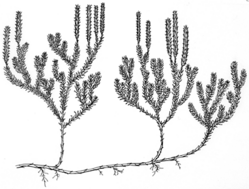
Description: Terrestrial or epiphytic plants.
Leaves simple, usually small, with a single vein, often scale-like; leaves that bear sporangia in their axils (sporophylls) either similar to the sterile leaves and arranged in fertile zones on the aerial stems, or modified and aggregated into cone-like strobili.
Spores of one kind only.
Distribution and occurrence: World: 4 genera, > 381 species, pantropical to southern temperate regions. Australia: 4 genera, 22 species, all States, chiefly from Qld to Tas.
External links:
Wikipedia It is now generally accepted that the family Lycopodiaceae contains four genera, following Xllgard (1987, 1989). Two new genera (Lycopodiella and Huperzia) are now included in this revised treatment, as well as the following name changes.
Phylloglossum is included in the key below because P. drummondii occurs in WA, SA, Vic and Tas, and could, possibly, occur in far south coastal health, but the species is not recorded from NSW. See VicFlora for a description. Note added K.L. Gibbons, May 2022.
Text by Peter G. Wilson
Taxon concept:
| | Key to the genera | |
| 1 | Leaves <10, quill-like and tufted at the top of the short tuberous stem; strobilus on a simple leafless fleshy peduncle | Phylloglossum |
| Leaves numerous, small and often scale-like and overlapping on the long branching stems; strobili if present on simple or branched leafy peduncles | 2 |
| 2 | Plants tufted, with branching mostly close to the base of the plant, shoots monomorphic, lacking branched rhizome or creeping stem; | 3 |
| Plants creeping, branches arising along the length of shoots, shoots dimorphic, with creeping shoots or rhizome and erect branches
Back to 1 | 4 |
| 3 | Sporophylls similar to vegetative leaves, branches often growing on beyond fertile part of stem | Huperzia |
| Sporophylls differentiated from vegetative leaves, branches often terminated by long filiform strobili
Back to 2 | Phlegmariurus |
| 4 | Erect stems branching more than twice; strobili terminating branchlets, erect | Lycopodium |
| Either erect stems unbranched or sometimes once or twice branched and strobili erect, lateral or terminal, or if erect stems more branched then strobili pendent and numerous
Back to 2 | Lycopodiella |
|