Common name: Merran's Sun-orchid, Sun Orchid
Thelymitra merraniae Nicholls APNI* Synonyms: Thelymitra xmerraniae Nicholls APNI*
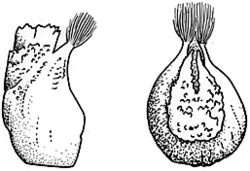
Description: Terrestrial herb.
Leaf linear, to 12 cm long and 7 mm wide, dark green.
Inflorescence to 20 cm high, 2–6-flowered. Perianth segments to 16 mm long, pale greenish blue with or without darker spots (opening tardily). Column to 6 mm long, purplish. Midlobe crest with dense calli-papillae; accessory lobes fusing with the crest to form a discontinuous ridge in which the 2, yellow, obliquely flaring, scalloped wings grade into a low, central notch-gap. Lateral arms erect, yellow, with hair tufts tinted pinky-mauve.
Flowering: October–November
Distribution and occurrence: Grows in wet heath, sometimes in peaty soils; south from Nowra district.
NSW subdivisions: CC, SC
Other Australian states: Vic. S.A.
Column characters intergrade with T. ixioides>/i>. It has been suggested that T. merraniae is a hybrid swarm representing backcrossed generations of T. ixioides and a species with a hooded midlobe (e.g. T. nuda or T. pauciflora).
APNI* Provides a link to the Australian Plant Name Index (hosted by the Australian National Botanic Gardens) for comprehensive bibliographic data
***The AVH map option provides a detailed interactive Australia wide distribution map drawn from collections held by all major Australian herbaria participating in the Australian Virtual Herbarium project.
|