|
|
|
WattleWeb
The Wattle as the National Floral Emblem
Wattle Day had its beginnings in the patriotism and national pride of the early native-born Australians. In 1835 the Australian Patriotic Association, comprising people born in Sydney, was formed. On the 10th August 1853 an anti-transportation (of convicts) march, under an archway of wattles, was held in Hobart. The Victorian Natives Association was formed in 1871, and in the following year the Australian Natives Association was established. Its aim was to promote the welfare of, and protect the interests of Australians, and was a force in the move towards the 1901 Federation of Australia. All the members were men. To involved the ladies, a Wattle Blossom League was formed in Adelaide in 1889 with the aim of instilling patriotism in the Australian population by wearing a sprig of wattle on official occasions. A Wattle Club was founded in Victoria in 1899 to promote September as a time to recognise the flower as a symbol of patriotism. In Sydney in 1901, the 1st September was recognised as Wattle Day. On the 20th August 1909, the Director of the Sydney Botanic Gardens, J.H. Maiden, called a meeting in Sydney of all interested people. This meeting establised the Wattle Day League, and on the 1st September 1910, the first Wattle Day celebration was held in Sydney and Melbourne and in Adelaide in 1911. The South Australian committee sent sprays of A. pycnantha to parliamentarians and other dignitaries with the suggestion that the species be
|
"On Wattle day we remind ourselves that we are Australians, with a bright and healthy outlook on life, and a golden anticipation of a happy future...
The Golden Wattle is a symbol of our material and spiritual wealth, and helps us to realise that we are one nation, one people, aiming at a unity of outlook which goes so far to make greatness in a nation"
|
K.R. Cramp, Australian Wattle League
| |
recognised as the nation floral emblem. It was incorporated into the Coat of Arms in 1913 on the recommendation of the then Prime Minister, Andrew Fisher. It figured prominently in the patriotic efforts during the 1914-18 First World War, but it had not been formally recognised as Australia's floral emblem. In 1917 in New South Wales the date was changed from the 1st September to the 1st August, since by the former time, most wattle had finished flowering and was unavailable for sale. Wattle Day was a day of national pride. The institution of Anzac Day, however, displaced this day of national pride and celebration of Wattle Day declined. The uncertainty of the date caused confusion and Wattle Day celebrations were maintained mainly by the schools82. Not until 1988 after persistent representation to the state and national governments during the early 1980's by Maria Hitchcock of Armidale,
New South Wales, was Acacia pycnantha finally declared as the
national floral emblem. The declairation took place on the 1st September
 in the National Botanic Gardens in Canberra with the planting of six
A. pycnantha plants. A. pycnantha now adorns the insignia of
in the National Botanic Gardens in Canberra with the planting of six
A. pycnantha plants. A. pycnantha now adorns the insignia of
 the Order of Australia and the gold and green colours of the wattle are
Australia's national colours. Wattle Day, as a day to celebrate Australia's
unique native flora is now celetrated on the 1st September in
all Australian States and Territories.
the Order of Australia and the gold and green colours of the wattle are
Australia's national colours. Wattle Day, as a day to celebrate Australia's
unique native flora is now celetrated on the 1st September in
all Australian States and Territories.
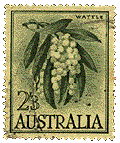
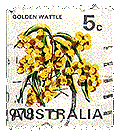
Wattles have appeared on Australian stamps and coins, and in the
identity symbols of some medical and military insignia. There are
also numerous literary images of wattles in our early poetry and prose82.
|

 Written and compiled by
Terry Tame
Written and compiled by
Terry Tame