Allocasuarina diminuta L.A.S.Johnson APNI* 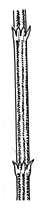
Description: Dioecious or monoecious shrub or small tree 1–5 m high.
Branchlets to 23 cm long; articles often with a waxy bloom, 5–12 mm long, 0.5–1.1 mm diam.; teeth broad- to narrow-triangular, more or less straight-sided, erect to spreading.
Male spikes 0.5–5 cm long, with 5–10 whorls of flowers per cm of spike length.
Cone body 5–20 mm long, 5–12 mm diam.; bracteoles truncate to broad-acute. Samara 3.5–5.0 mm long.
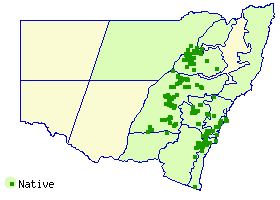
Distribution and occurrence: In heath or low open woodland on sandstone ridges and hillsides.
NSW subdivisions: NC, CC, SC, CT, ST, NWS, CWS, SWS, NWP
Three closely related subspecies are recognised.
Text by K. L. Wilson & L. A. S. Johnson (1990); edited KL Wilson (Feb 2014)
Taxon concept:
| | Key to the subspecies | |
| 1 | Ridges rounded-convex (occasionally only slightly so); teeth 6 or 7, narrow-triangular usually with straight margins; articles often with waxy bloom. Shrub 2–5 m high. Teeth 6 or 7, 0.3–0.5 mm long. Anther 0.5–0.7 mm long. Cone bracteoles obtuse to truncate | subsp. diminuta |
| Ridges angular to rounded-convex; teeth 6–10 | 2 |
| 2 | Teeth broad-triangular with convex margins; articles often with waxy bloom. Shrub 1–2.5 m high. Teeth 6–10, 0.3–0.6 mm long. Anther 0.5–0.7 mm long. Cone bracteoles obtuse to broad-acute | subsp. mimica |
| Teeth broad- or narrow-triangular with straight or somewhat convex margins; articles not waxy. Shrub 1–2.5 m high. Teeth 6–8, 0.4–0.8 mm long. Anther 0.6–0.8 mm long. Cone bracteoles obtuse to truncate
Back to 1 | subsp. annectens |
APNI* Provides a link to the Australian Plant Name Index (hosted by the Australian National Botanic Gardens) for comprehensive bibliographic data
***The AVH map option provides a detailed interactive Australia wide distribution map drawn from collections held by all major Australian herbaria participating in the Australian Virtual Herbarium project.
|