Allocasuarina gymnanthera L.A.S.Johnson APNI* Synonyms: Casuarina gymnanthera APNI*
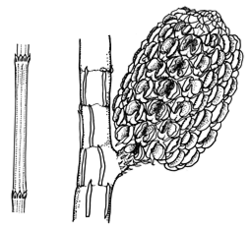
Description: Dioecious shrub or small tree 2–5 m high.
Branchlets to 20 cm long; articles 5–12 mm long, 0.5–1.0 mm diam.; teeth 6–8 (rarely 9), erect, not withering, 0.4–0.7 mm long.
Cones often with small sterile apex to 3 mm long, peduncle 3–8 mm long; bracteoles obtuse or truncate.
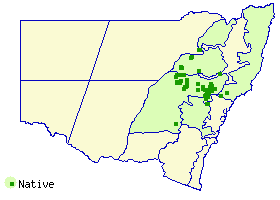
Distribution and occurrence: From southern Pilliga Scrub to lower Goulburn Valley (Ulan and Baerami), upper Hunter Valley (near Singleton) and to Glen Davis; NC CT NWS CWS. In low open woodland on sandy soils on sandstone ridges.
NSW subdivisions: NC, CT, NWS, CWS
Text by K. L. Wilson & L. A. S. Johnson (1990); edited KL Wilson (Feb 2014, April 2023)
Taxon concept: Flora of NSW 1 (1990)
APNI* Provides a link to the Australian Plant Name Index (hosted by the Australian National Botanic Gardens) for comprehensive bibliographic data
***The AVH map option provides a detailed interactive Australia wide distribution map drawn from collections held by all major Australian herbaria participating in the Australian Virtual Herbarium project.
|