Common name: Mossgiel Daisy
Brachyscome papillosa G.L.Davis APNI* Synonyms: Brachycome papillosa G.L.Davis APNI*
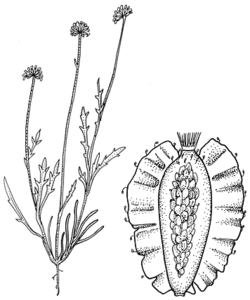
Description: Erect perennial to 36 cm high, glandular- and septate-hairy, young shoots woolly.
Leaves cauline, up to 7 cm long, margins entire to deeply pinnatisect with acute lobes to 7 mm long; sessile.
Heads solitary, 6–11 mm diam.; peduncle 10–25 cm long; involucral bracts elliptic, acute, glandular- and septate-hairy, lacerate. Ray florets mauve; ligule c. 8 mm long.
Achenes broad-obovate, 2–3.5 mm long, golden-brown; faces with dense flattened papillae; wings as broad as body, margins ciliolate, entire and undulating; pappus of equal bristles c. 0.25 mm.
Flowering: June–December
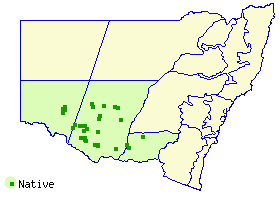
Distribution and occurrence: Grows on saltbush plains; chiefly from Mossgiel to Urana.
NSW subdivisions: SWS, SWP, SFWP
Threatened species: NSW BCA: Vulnerable; Commonwealth EPBC: Vulnerable
This species is considered data-deficient by Saving our Species (SoS, DPIE) which means a conservation project cannot be developed for it. Visit their website and contact SoS if you have additional information.
Text by J. Everett
Taxon concept: Flora of NSW 3 (1992)
APNI* Provides a link to the Australian Plant Name Index (hosted by the Australian National Botanic Gardens) for comprehensive bibliographic data
***The AVH map option provides a detailed interactive Australia wide distribution map drawn from collections held by all major Australian herbaria participating in the Australian Virtual Herbarium project.
|