Carex buxbaumii Wahlenb. APNI* Description: Loosely tufted; rhizome short. Culms triquetrous, smooth below, scabrous above, 25–70 cm long, c. 1.3 mm diam.
Leaves shorter than to scarcely exceeding culms, 1.5–3 mm wide.
Inflorescence 4–10 cm long, with 2–5 spikes solitary at nodes; lowest involucral bract shorter than to exceeding inflorescence. Spikes sessile, more or less contiguous, spreading slightly at maturity, 0.7–2.5 cm long; uppermost spike gynaecandrous; lower spikes female. Male and female bracts ('glumes') acuminate to acute, often long-mucronate (mucro to 1.5 mm long), red-brown to dark red-brown with paler midrib; female bracts 3–6 mm long. Perigynia (utricles) ovoid to narrow-ellipsoid, nerveless or indistinctly nerved, 3.0–4.5 mm long, c. 2 mm diam., minutely papillose, pale green to brown; beak a minute notch to 0.2 mm long. Style 3-fid.
Nut obovate to elliptical in outline.
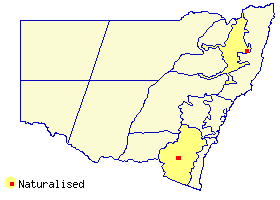
Distribution and occurrence: Naturalised in Cathedral Rock Nat. Park (NTablelands) and Scabby Range Nature Reserve (ST); also sparingly naturalised in NE Vic and Tas. Native of Europe. Swampy flats at higher altitdue.
NSW subdivisions: *NT, *ST
Other Australian states: *Vic. *Tas.
Text by Karen L. Wilson (1996; edited Aug 2011, Aug 2016)
Taxon concept: Karen Wilson in Telopea 6(4): 572 (1996)
APNI* Provides a link to the Australian Plant Name Index (hosted by the Australian National Botanic Gardens) for comprehensive bibliographic data
***The AVH map option provides a detailed interactive Australia wide distribution map drawn from collections held by all major Australian herbaria participating in the Australian Virtual Herbarium project.
|