Common name: River Oak, River Sheoak
Casuarina cunninghamiana Miq. APNI* Description: Dioecious tree 15–35(–50) m high with branchlets drooping in vigorous specimens, erect in depauperate specimens.
Articles 6–9 mm long, 0.4–0.6 mm diam.; edges of furrows often marked (in dried specimens) by a slight ridge; teeth erect, withering, 0.3–0.5 mm long.
Anther 0.4–0.7 mm long.
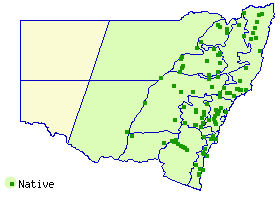
Distribution and occurrence: Eastern NSW and Qld; other subspecies in the Top End of the NT and the base of the Gulf of Carpentaria in Qld. along permanent freshwater streams.
NSW subdivisions: NC, CC, SC, NT, CT, ST, NWS, CWS, SWS, NWP, SWP
Other Australian states: Qld
Text by K. L. Wilson & L. A. S. Johnson (1990); edited KL Wilson (Feb 2014; Dec 2016)
Taxon concept:
| N.S.W. occurrences are: subsp. cunninghamiana |
APNI* Provides a link to the Australian Plant Name Index (hosted by the Australian National Botanic Gardens) for comprehensive bibliographic data
***The AVH map option provides a detailed interactive Australia wide distribution map drawn from collections held by all major Australian herbaria participating in the Australian Virtual Herbarium project.
|