Common name: Swamp Oak, Guman (Cadigal name)
Casuarina glauca Sieber ex Spreng. APNI* 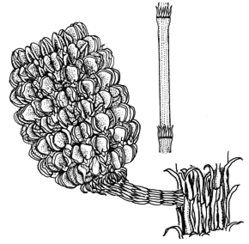
Description: Dioecious tree 8–20(-35) m high, frequently producing root suckers; branchlets drooping.
Articles noticeably thicker at their apex than towards the base when dried, 8–20 mm long, 0.9–1.2 mm diam.; teeth erect, 12–20, 0.6–0.9 mm long; teeth on young permanent shoots long-recurved.
Anther c. 0.8 mm long.
Cone body 9–18 mm long, with broad-acute bracteoles.
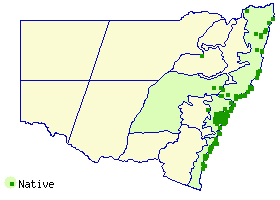
Distribution and occurrence: In brackish situations along coastal streams, somewhat farther inland along major river valleys. Often forming pure stands. It is the dominant species in the Swamp Oak Floodplain Forest of the NSW North Coast, Sydney Basin and South East Corner bioregions, which is regarded as likely to become extinct because of high rates of clearing for human activities - see http://www.environment.nsw.gov.au/determinations/swampoak36a.htm
NSW subdivisions: NC, CC, SC, CWS, *LHI
Other Australian states: Qld
Also found as a shrub, prostrate to c. 2 m high, with coarse branchlets bearing up to 20 teeth, on exposed coastal headlands. This natural form has been brought into horticulture under several cultivar names. Hybridizes with C. cunninghamiana subsp. cunninghamiana where their ranges meet along coastal rivers.
Text by K. L. Wilson & L. A. S. Johnson (1990); edited KL Wilson (Feb, April 2014; Dec 2016; Oct 2019)
Taxon concept: Flora of NSW 1 (1990)
APNI* Provides a link to the Australian Plant Name Index (hosted by the Australian National Botanic Gardens) for comprehensive bibliographic data
***The AVH map option provides a detailed interactive Australia wide distribution map drawn from collections held by all major Australian herbaria participating in the Australian Virtual Herbarium project.
|