Common name: Black Oak, Belah, Kariku
Casuarina pauper F.Muell. ex L.A.S.Johnson APNI* Synonyms: Casuarina cristata subsp. pauper (Miq.) L.A.S.Johnson APNI*
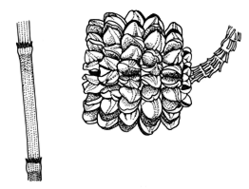
Description: Dioecious tree, usually smaller and of poorer form than C. cristata, rarely to 20 m tall.
Articles 1.0–1.8 mm diam., strongly waxy, densely and very shortly hairy; teeth spreading to recurved, 9–13, 0.8–0.9 mm long; teeth on new shoots spreading.
Cones usually persistently rusty-pubescent, cone bracteoles shorter, samara 5.5–7.0 mm long (see also characters in key).
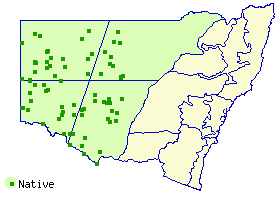
Distribution and occurrence: Widespread in the W of the State; also in far SW Queensland, NW Victoria, inland South Australia and southern inland Western Australia. Usually grows on red-brown soils with light-textured topsoil.
NSW subdivisions: NWP, SWP, NFWP, SFWP
Other Australian states: Qld Vic. W.A. S.A.
There is some intergradation between C. pauper and C. cristata from Bourke to southwest of Hillston.
Text by K. L. Wilson & L. A. S. Johnson 1990; edited KL Wilson (Aug 2007, Feb 2014, March 2021).
Taxon concept: Flora of NSW 1 (1990)
APNI* Provides a link to the Australian Plant Name Index (hosted by the Australian National Botanic Gardens) for comprehensive bibliographic data
***The AVH map option provides a detailed interactive Australia wide distribution map drawn from collections held by all major Australian herbaria participating in the Australian Virtual Herbarium project.
|