PlantNET Home DONATE TODAY | PlantNET Home | Search NSW Flora | Contact Us  
FloraOnline
Introduction
Plant Name Search
Index Search
Spatial Search
Identification Keys
Classification
Glossary
WeedAlert
Telopea Journal
Other Data Sources
NEW SOUTH WALES FLORA ONLINE Printable Page

Haemodorum planifolium R.Br.
Family Haemodoraceae
Common name: Strap-leaved Bloodroot

Haemodorum planifolium R.Br. APNI*
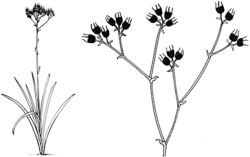
Description: Herb 65–85 cm tall. Bulb 8–20 cm below the soil surface, red.

Basal leaves 4–8; lamina linear, flat, (210–)250–440 mm long, 3.5–4.4 mm wide. Leaves on scape usually reduced, sometimes 1–3 leaf-like and green, transitioning to brownish or blackish bracts, lowest bract to 180 mm long.

Inflorescences 1(–3) per plant, paniculate; scape 640–840 mm long, glaucous-green to blackish; flowering portion 100–150 mm long from lowest major branch, with 1–4 major branches 20–160 mm long, the branches narrowly spreading at 30–55° from main axis; secondary branches (excluding within flower aggregations) 0–1; flowers arranged in dense cymose aggregations, terminal on the main axis and each major and secondary branch (when present), flowers 9–30 in terminal aggregation, 5–19 in branch aggregations; terminal aggregation exceeded by those on the branches. Pedicels 4–11 mm long. Bracteoles 2, similar, 6.5–8.5 mm long, narrowly lanceolate, acute, opaque, the texture fairly thick, without a differentiated broad membranous margin, veins 5, prominent and raised when dry; upper bracteole attached 1–2 mm below the flower base, apex at 1/4–1/2 of the flower length. Flowers (8–)9–16 mm long; sepals similar to petals, subequal or up to 1 mm shorter than petals, lanceolate, becoming narrowly linear when dried except for the broader unexpanded base which is 1.6–2.5 mm wide, mostly dark brownish but sometimes with a purplish or greenish tint, somewhat saccate base when dried; petals (6.6–)8.7–15 mm long, dark brown but sometimes with a purplish or greenish tint. Stamens equal, enclosed in perianth; filaments yellowish, 4.1–7.0 mm long; anthers versatile, 3.4–4.0 mm long, yellow, the tip 2.2–4.7 mm below petal apex. Style (9.5–)11.2–14.0 mm long, orange in upper part, yellowish or greenish in lower 1/3 at anthesis, equal to or up to 1.2 mm longer than the petals; stigma entire but slightly capitate, minutely papillose, positioned 2.8–4.2 mm above the tip of the anthers.

Fruits dark brown to blackish, glossy, 10–13 mm diameter. Seeds not seen.


Flowering: Flowering from November to December. Fruiting from December to February.

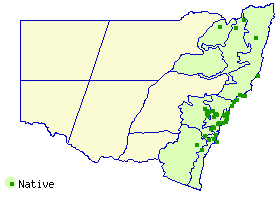
Distribution and occurrence: From Gosford south to Wollongong, extending inland to Barren Grounds and the Newnes Plateau (Greater Blue Mountains) in NSW.

On sandstone substrates, though sometimes in coastal situations that are also limestone-rich, often in run-on zones that are seasonally wet, usually in low heath or open woodland.
NSW subdivisions: CC, CT
AVH map***

The concept of Haemodorum planifolium was breviously broader, including three species now separated from the concept, i.e.: Haemodorum brevistylum, Haemodorum celsum and Haemodorum collevatum. It has a narrow, compact inflorescence with flowers in aggregations of 5-30.

Text by T.D. Macfarlane & R.L. Barrett, September 2025
Taxon concept: T.D. Macfarlane & R.L. Barrett, Nuytsia 36: 135-138 (2025)


APNI* Provides a link to the Australian Plant Name Index (hosted by the Australian National Botanic Gardens) for comprehensive bibliographic data
***The AVH map option provides a detailed interactive Australia wide distribution map drawn from collections held by all major Australian herbaria participating in the Australian Virtual Herbarium project.
  Privacy | Copyright | Disclaimer | About PlantNET | Cite PlantNET