Common name: Tarata, Lemonwood, Tarata, Kihihi
Pittosporum eugenioides A.Cunn. APNI* Description: Densely branched shrub or tree to 6 (–13)m high.
Leaves alternate, clustered or whorled at branch-tips, lemon-scented when crushed; petiole 10–20 mm long; lamina lanceolate to oblanceolate or elliptic, 50–150 mm long, 25–40 mm wide, coriaceous, glossy, glabrous, margin entire and usually undulate.
Inflorescence a terminal subcorymbose compound umbel (30–70-flowered); peduncles 10–20 mm long. Flowers: sweetly-scented unisexual or occasionally bisexual; pedicels 4–6 mm long. Sepals free, ovate to narrowly ovate, c. 2 mm long. Petals narrowly oblong, 5–7 mm long, 1–2 mm wide, free, spreading from base, cream to yellowish. Ovary pubescent. Flowering: October to December
Fruits a globose to ovoid capsule, 5–7 (–10 ) mm long, 5–6 mm diam., 2-valved (rarely 3-valved), dark brown to black at maturity, glabrous, inner face smooth, yellowish; seeds few, 2.5–3.5 mm long, dark reddish brown to blackish, immersed in a viscid pulp, covered by papery endocarp at dehiscence.
Flowering: October to December.
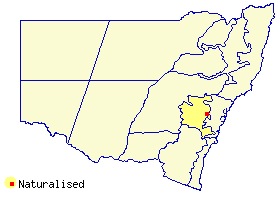
Distribution and occurrence: Cultivated as a hedge or specimen shrub. Naturalised in dry or wet sclerophyll forest, mainly in disturbance and transition zones such as roadsides, along watercourses, and forest margins. Other Australian states: Vic., Tas.
NSW subdivisions: *CT
Text by modified by T. C. Wilson, 26 January 2026 Taxon concept: R.O. Makinson. Pittosporum eugenioides, in P.G. Kodela (ed.), Flora of Australia. Australian Biological Resources Study, Department of Climate Change, Energy, the Environment and Water: Canberra. https://profiles.ala.org.au/opus/foa/profile/Pittosporum%20eugenioides [Date Accessed: 26 January 2026]; original concept: Cayzer, L. (2002). Pittosporaceae, in Spencer, R. (ed.), Horticultural Flora of South-eastern Australia Volume 3. Flowering Plants - Dicotyledons Part 2: 11–23. (University of New South Wales Press: Sydney).
APNI* Provides a link to the Australian Plant Name Index (hosted by the Australian National Botanic Gardens) for comprehensive bibliographic data ***The AVH map option provides a detailed interactive Australia wide distribution map drawn from collections held by all major Australian herbaria participating in the Australian Virtual Herbarium project.
|