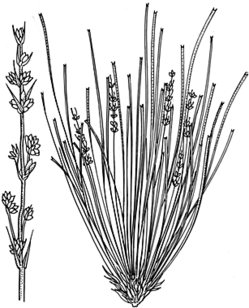
Leaves with distinctive sheathing basal margins, linear or terete, glabrous, papillose, warty or hairy; apex entire or toothed.
Male and female inflorescences similar or dissimilar, spike-like, raceme-like or panicle-like; flowers separate or in dense or open clusters, small. Female perianth usually larger than male, hardened in fruit; tepals free or fused, all similar or the outer tepals thinner. Outer stamens sometimes inserted on rim of perianth tube; inner inserted on perianth, close to or distant from the outer, their filaments ± different in length. Ovary ± sessile; ovule 1 per loculus; style short.
Capsule globose, cylindrical or trigonous; seeds globose to ellipsoidal, brown, orange or reddish.
| | Key to the species | |
| 1 | Mature and undamaged leaf tips distinctly toothed either with 2 marginal teeth and a clean sinus (longer or shorter than marginal teeth) or with 3 distinct teeth and small marginal teeth, irregularly disposed near the apex, with the central tooth clearly a sinus, or small marginal teeth exceeding 2 lateral teeth | 2 |
| Leaves not distinctly toothed at apex, with entire, acute or rounded apex, or with 2 or 3 irregular minute points near the apex eroding at maturity, occasionally persisting in Lomandra filiformis subsp. filiformis and L. coriacea | 8 |
| 2 | Flowers 4–7 mm long; male flowers with pedicels to 1 cm, and arranged separately along axes | Lomandra effusa |
| Flowers mostly 2–3 mm long; male flowers sessile, clustered, usually whorled on axes, occasionally clusters reduced to few or 1 flower
Back to 1 | 3 |
| 3 | Male inflorescence usually unbranched; female inflorescence unbranched or rarely branched | 4 |
| Male inflorescence branched; female inflorescence branched or unbranched
Back to 2 | 6 |
| 4 | Leaves 4–12 mm wide; male rachis 10–30 cm long | Lomandra spicata |
| Leaves usually less than 4 mm wide; male rachis less than 8 cm long
Back to 3 | 5 |
| 5 | Leaves soft, thin, and flexible, 2–4 mm wide; grows near waterfalls | Lomandra montana |
| Leaves firmer in texture, up to 1.5 mm wide, widespread, usually not near waterfalls
Back to 4 | Lomandra confertifolia |
| 6 | Leaves less than 3 mm wide | Lomandra fluviatilis |
| Leaves more than 4.5 mm wide
Back to 3 | 7 |
| 7 | Inflorescence much branched, with usually 4 or more primary branches per node, often pale green in aspect, usually near watercourses | Lomandra hystrix |
| Inflorescence less branched, usually with 2 primary branches per node, aspect cream-yellowish, in varied situations including creek beds and banks, as well as dry rocky hillsides
Back to 6 | Lomandra longifolia |
| 8 | Flowers in distinct clusters, male flowers sessile to long pedicellate | 9 |
| Flowers separate, (or up to 3 at node), male flowers pedicellate, pedicels at least 1 mm long
Back to 1 | 15 |
| 9 | Bracts subtending flowers forming a mass of crinkly hairs | Lomandra leucocephala |
| Bracts subtending flowers entire or only slightly split; inflorescence not as above
Back to 8 | 10 |
| 10 | Tepals divided to base | 11 |
| Tepals fused in lower half
Back to 9 | 12 |
| 11 | Inflorescence simple or few- to many-branched, the axes minutely rough, scape not flattened; male flowers usually 2–3 mm long, pedicellate at anthesis, pedicel 3–8 mm long | Lomandra multiflora |
| Inflorescence (at least male) much-branched, the axes smooth, scape flattened; male flowers usually 4–6 mm long, sessile or on a pedicel with up to 1 mm visible above bracts
Back to 10 | Lomandra patens |
| 12 | Margins of leaf sheaths intact (sometimes lacerating when old), auriculate at top, white; leaves usually less than 4 cm long, often twisted and/or recurved from stem | Lomandra obliqua |
| Margins of leaf sheaths more or less lacerated, lattice like; leaves usually more than 4 cm long; usually not twisted or recurved from stem
Back to 10 | 13 |
| 13 | Margins of leaf sheaths abruptly narrowed at top (obvious on young leaves); leaf apex short-acute (to rounded truncate); eastern parts of State | 14 |
| Margins of leaf sheaths gradually narrowed at top; apex long-acute; western plains species
Back to 12 | Lomandra collina |
| 14 | Stems decumbent, prostrate or ascending; male inflorescence branched or unbranched, usually 10 cm long; male scape usually not exposed above leaf bases or rarely exposed up to 2.5 cm; leaves usually 8–20 cm long, up to 4 times as long as male inflorescence, leaf apex shortly acute to rounded-truncate | Lomandra glauca |
| Stems not decumbent, plants normally tufted; male inflorescence unbranched, usually 5–8 cm long; male scape exposed c. 1 cm above leaf bases; leaves usually 25–40 cm long, at least 5 times as long as male inflorescence, leaf apex shortly acute
Back to 13 | Lomandra elongata |
| 15 | All tepals similar in size and shape, the flower widely open at maturity | Lomandra micrantha |
| Outer and inner tepals dissimilar (outer tepals shorter than inner tepals), the flower remaining bell-shaped
Back to 8 | 16 |
| 16 | Plants decumbent | Lomandra laxa |
| Plants tufted, sometimes sparsely so
Back to 15 | 17 |
| 17 | Leaves usually terete | Lomandra cylindrica |
| Leaves not terete but sometimes rolled into a complete cylinder
Back to 16 | 18 |
| 18 | Male inflorescence unbranched or narrowly pyramidal, 1 to few short branches in lower part; female inflorescence unbranched or with few branches | 19 |
| Male inflorescence clearly branched, more or less broadly pyramidal; female inflorescence branched or unbranched
Back to 17 | 20 |
| 19 | Leaves channelled to slightly inrolled, 0.5–1 mm wide, apex entire, margins of sheath finely lacerated; inflorescence axes smooth; flowers yellow, blackish when dried; male flowers usually 3 mm long, 3–4 mm diam. with pedicel 3–4 mm long | Lomandra brevis |
| Leaves flat, channelled or rolled, 0.5–4 mm wide or wider, apex entire or with 2 or 3 minute irregular points sometimes eroded, margins of sheath with some lacerations, more or less smooth; inflorescence axes smooth or scabrous; flowers yellow, not usually blackened when dried; male flowers usually 1.5 mm long, 1.5–2 mm diam. with pedicel usually 2–3 mm long
Back to 18 | Lomandra filiformis |
| 20 | Male inflorescence short; flowers crowded; scape short or obscure among the leaf bases | 21 |
| Male inflorescence sometimes short but flowers well spaced; scape short or long
Back to 18 | 22 |
| 21 | Outer bracts large and white, conspicuous relative to the very small flowers; female flowers scarcely distinguishable from the male without dissection | Lomandra bracteata |
| Outer bracts not large and white but bracts subtending lower branches of inflorescence sometimes conspicuous; female flowers readily distinguishable from the male
Back to 20 | Lomandra filiformis |
| 22 | Branches of the inflorescence predominantly alternate | 23 |
| Branches of the inflorescence predominately opposite or whorled
Back to 20 | Lomandra laxa |
| 23 | Leaves semiterete | Lomandra cylindrica |
| Leaves usually channelled, folded, inrolled or flat
Back to 22 | 24 |
| 24 | Leaf sheath margins dark purplish brown; inflorescence usually large, open, the axes smooth at least in male | Lomandra gracilis |
| Leaf sheath margins pale or white, occasionally partly purplish brown; inflorescence small to large, the axes sometimes more or less scabrid near apex
Back to 23 | Lomandra filiformis |