Common name: little harsh acacia , rough-leaved acacia , rough hairy wattle
Acacia hispidula (Sm.) Willd. APNI* Synonyms: Racosperma hispidulum (Sm.) Mart. APNI*
Mimosa hispidula Sm. APNI*
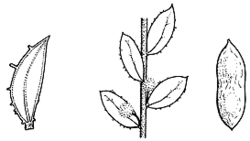
Description: Erect or spreading shrub 0.5–2 m high; branchlets ± terete, densely hispid.
Phyllodes ± elliptic to narrowly elliptic, asymmetric, usually slightly curved, 1–3 cm long, 3–10 mm wide, densely hispid to ± glabrous, midvein prominent, lateral veins faint forming an obscure open reticulum, margins thickened and with prominent tuberculate-based hairs, apex acute with a mucro; 1 minute gland 2–6 mm above pulvinus; pulvinus to 1 mm long.
Inflorescences simple, 1 in axil of phyllodes; peduncles 4–7 mm long, hairy; heads globose, 10–20-flowered, 5–8 mm diam., pale yellow to nearly white.
Pods ± straight, ± flat, 1.5–2.5 cm long, 6–10 mm wide, thickly leathery to thinly woody, glabrous; seeds 1 or 2, longitudinal; funicle expanded towards seed.
Flowering: mainly January–April.
Distribution and occurrence: chiefly in coastal localities north from Nowra district, especially common in Sydney region, also on granite from Torrington to Silent Grove. Grows mainly in dry sclerophyll forest, often on sandstone outcrops.
NSW subdivisions: NC, CC, SC, NT, NWS
Other Australian states: Qld
May be confused with Acacia aspera which has longer and narrower phyllodes. Seemingly related to Acacia purpureopetala from Qld. The name refers to the rough nature of the plant due to branchlets and phyllode margins having short hairs or tubercles.
Text by P.G. Kodela (last update Mar 2012)
Taxon concept: P.G. Kodela & G.J. Harden, Flora of NSW Vol. 2 (2002)
APNI* Provides a link to the Australian Plant Name Index (hosted by the Australian National Botanic Gardens) for comprehensive bibliographic data
***The AVH map option provides a detailed interactive Australia wide distribution map drawn from collections held by all major Australian herbaria participating in the Australian Virtual Herbarium project.
|







.jpg)
.jpg)

