Common name: white wattle
Acacia linifolia (Vent.) Willd. APNI* Synonyms: Acacia linearis (J.C.Wendl.) J.F.Macbr. APNI*
Racosperma linifolium (Vent.) Pedley APNI*
Mimosa linearis J.C.Wendl. APNI*
Mimosa linifolia Vent. APNI*
Mimosa abietina (Willd.) Poir. APNI*
Acacia abietina Willd. APNI*
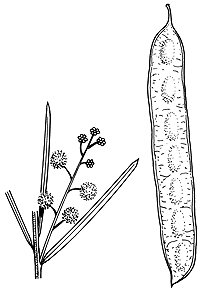
Description: Erect or spreading shrub 1.5–4 m high; bark smooth or finely fissured, greyish; branchlets angled towards apices, finely ridged, glabrous or sometimes hairy.
Phyllodes ± linear, ± straight, 2–5 cm long (range: 1.5–7 cm), 0.7–2.5 mm wide (rarely to 3 mm wide), usually glabrous except pulvinus and upper margin near base often sparsely minutely hairy (phyllodes sometimes finely hairy and glabrescent), midvein prominent, lateral veins obscure or not evident, apex acute with a mucro; 1 minute gland 5–15 mm above pulvinus; pulvinus 0.5–2 mm long.
Inflorescences 5–17 in an axillary raceme; axis 2–5 cm long; peduncles 2–5 mm long, slender, glabrous or sometimes hairy; heads globose, 6–12-flowered, 4–5.5 mm diam., pale yellow to ± white.
Pods straight or curved, ± flat except raised over seeds, ± straight-sided or barely constricted between seeds, often more deeply constricted between some seeds, 3–12 cm long, 8–15 mm wide, thinly leathery, glabrous, often ± pruinose; seeds longitudinal; funicle expanded towards seed.
Flowering: throughout year.
Distribution and occurrence: chiefly from the Hunter Valley south to the Hill Top district, common in the Sydney region; also recorded at Narooma. Grows in dry sclerophyll forest, woodland and heath in sandy, often skeletal soils on sandstone, also in clayey soils on shale.
NSW subdivisions: NC, CC, CT
The name refers to the likeness of the phyllode to the flax leaf. Variable in phyllode width, occasionally approaching subterete. Similar to Acacia boormanii which has bright yellow flower heads and grey-green phyllodes, and to A. meiantha which has brighter yellow flower heads and branchlets and peduncles with short stiff hairs. A variant from the Mount Howes region is recognized by phyllodes being very slender, 0.5-1 mm wide, flat to ± terete, with midvein obscure or absent, and branchlets, peduncles and raceme axes being frequently hairy.
Text by P.G. Kodela
Taxon concept: P.G. Kodela & G.J. Harden, Flora of NSW Vol. 2 (2002)
APNI* Provides a link to the Australian Plant Name Index (hosted by the Australian National Botanic Gardens) for comprehensive bibliographic data
***The AVH map option provides a detailed interactive Australia wide distribution map drawn from collections held by all major Australian herbaria participating in the Australian Virtual Herbarium project.
|