Common name: sweet wattle
Acacia suaveolens (Sm.) Willd. APNI* Synonyms: Racosperma suaveolens (Sm.) Mart. APNI*
Acacia suaveolens subsp. myallensis D.A.Morrison & A.J.Rupp APNI*
Acacia suaveolens subsp. prostrata D.A.Morrison & A.J.Rupp APNI*
Acacia suaveolens subsp. montana D.A.Morrison & A.J.Rupp APNI*
Acacia angustifolia (Jacq.) H.L.Wendl. APNI*
Mimosa obliqua Lam. APNI*
Mimosa suaveolens Sm. APNI*
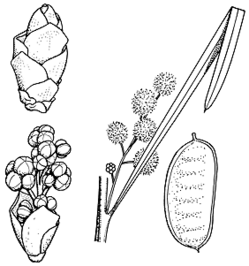
Description: Prostrate to erect shrub 0.3–2.5 m high; bark smooth, purplish brown or light green; branchlets angled or flattened, glabrous.
Phyllodes narrowly oblanceolate or very narrowly elliptic to linear, straight to slightly curved, 5–15 cm long, 2–10 mm wide, glabrous, ± glaucous, midvein prominent, lateral veins obscure or not evident, margins ± prominent, apex acute with a mucro; 1 small gland near base and another normally at mucro; pulvinus 1–2 mm long.
Inflorescences usually 5–10 in an axillary raceme; axis 1–3 cm long; peduncles 1–5 mm long, glabrous; before opening raceme enclosed in imbricate bracts c. 5 mm long; heads globose, 3–10-flowered, 4–7 mm diam., pale yellow to ± white.
Pods ± straight, ± flat, ± straight-sided, 2–5 cm long, 8–19 mm wide, thinly leathery to brittle, glabrous, pruinose; margins prominent; seeds transverse; funicle expanded towards seed.
Flowering: April–September.
Distribution and occurrence: west to Mount Victoria. Grows in heath and dry sclerophyll forest or woodland, in sandy soil; chiefly on the coast.
NSW subdivisions: NC, CC, SC, CT, ST
Other Australian states: Qld Vic. Tas. S.A.
The name alludes to the sweet scent of the flowers. Similar to the South Australian species Acacia iteaphylla which is a more bushy shrub and has the seeds longitudionally placed in the pod. Several subspecies are recognized in Morrison & Rupp (1995). An individual plant with pink inflorescences and somewhat darker bluish green phyllodes has been recorded in the Sydney region, July 2011.
Text by P.G. Kodela (last updated July 2011)
Taxon concept: P.G. Kodela & G.J. Harden, Flora of NSW Vol. 2 (2002)
APNI* Provides a link to the Australian Plant Name Index (hosted by the Australian National Botanic Gardens) for comprehensive bibliographic data
***The AVH map option provides a detailed interactive Australia wide distribution map drawn from collections held by all major Australian herbaria participating in the Australian Virtual Herbarium project.
|