Juncus subsecundus N.A.Wakef. APNI* Synonyms: Juncus subsecundus subsp. congregatus ms APNI*
Juncus subsecundus subsp. subsecundus APNI*
Juncus radula var. laevior Buchenau APNI*
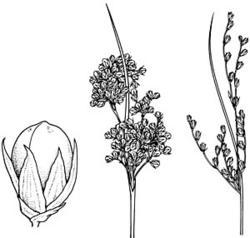
Description: Slender, shortly rhizomatous perennial. Culms terete, 25–70 (rarely to 90) cm long, 0.6–1.3 (occasionally to 2.2) mm diam., hard, grey-green; culm striations 15–30 (rarely to 40); pith interrupted.
Cataphylls 3–11 cm long, ± tight, abaxially straw-brown to dark yellow-brown at base, adaxially silvery.
Inflorescence pseudolateral, diffuse, 1–7 (rarely to 13) cm long; flowers numerous, solitary or loosely to densely clustered; lowest involucral bract 5–20 cm long, longer than inflorescence. Tepals straw-brown, occasionally red-tinged, with broad hyaline margins; outer tepals 2.0–4.0 mm long, longer than or equalling inner tepals. Stamens 3–6, shorter than outer tepals; anthers 0.5–0.8 mm long.
Capsule longer than or equalling or occasionally shorter than outer tepals, obovoid to ellipsoid, obtuse to acute, not or scarcely apiculate, golden brown to dark golden brown or red-brown near apex.
Flowering: spring–summer.
Distribution and occurrence: Widespread; not common on the Western Plains. Grows under wide range of soils and climatic conditions, usually more common on heavy soils in dryish habitats.
NSW subdivisions: NC, CC, SC, NT, CT, ST, NWS, CWS, SWS, NWP, SWP, NFWP
Other Australian states: Qld Vic. Tas. W.A. S.A.
A variable species, typically slender with a diffuse inflorescence but may be rather more robust with densely clustered flowers (in more inland areas of south-eastern Australia, extending to SW Vic, Tas and WA). Inflorescences are larger with flowers spread distantly along the branches in the most most inland localities.
Text by K. L. Wilson, L. A. S. Johnson & P. Bankoff (1993); edited KL Wilson (July 2016, Nov 2022, Feb 2024)
Taxon concept: Flora of NSW 4 (1993)
APNI* Provides a link to the Australian Plant Name Index (hosted by the Australian National Botanic Gardens) for comprehensive bibliographic data
***The AVH map option provides a detailed interactive Australia wide distribution map drawn from collections held by all major Australian herbaria participating in the Australian Virtual Herbarium project.
|